Frequently Asked Questions (FAQs)
- FPX
- MyDebit
- Credit Card - Visa or Master
- E-wallet - Boost, Grabpay, Touch N Go, ShopeePay
- Alipay / Union Pay
-
Malaysia Delivery (Peninsular & East Malaysia)
Please refer to the table below for overseas shipping rate and estimated delivery time. FREE delivery West Malaysia for purchase above RM300, East Malaysia purchase above RM400. Otherwise,
West Malaysia
- Shipping Rates : Flat rate Rm5
- Estimated Delivery Time : 2 to 5 working days
East Malaysia
- Shipping Rates : Flat rate Rm28
- Estimated Delivery Time : 4 to 7 working days
Overseas Delivery
Country : Singapore
- Shipping Rates : Flat rate Rm28
- Estimated Delivery Time : 5 to 10 working days.
- Note: Shipping fees do not include any taxes or duties. Any applicable charges during customs clearance must be borne by the recipient.
Country : Asia Country
- Shipping Rates : Flat rate Rm200
- Estimated Delivery Time : 2 to 3 weeks (Subject to custom clearance procedure).
- Note: Shipping fees do not include any taxes or duties. Any applicable charges during customs clearance must be borne by the recipient.
Country : United States, Europe and the Rest of the World rate
- Shipping Rates : Flat rate Rm300
- Estimated Delivery Time : 2 to 3 weeks (Subject to custom clearance procedure).
- Note: Shipping fees do not include any taxes or duties. Any applicable charges during customs clearance must be borne by the recipient.
IMPORTANT NOTES:
- Your parcel will be shipped from our Malaysia warehouse. The shipping fees that you have paid do not include taxes and duties levied by your country. If any taxes and duties are incurred for your parcel during customs clearance, the recipient shall be responsible for covering the fees before the parcel can be released.
If you are unable to track your package on the courier tracking page, it may be because your parcel has just been handed over to our courier partner. Tracking information will typically be available within 24 hours after shipment.
If you are still unable to track your parcel by the next business day after it has been shipped, please contact us at [email protected] with your order number and item details. Our team will assist you promptly to resolve the issue.
Unfortunately, our courier partners are unable to deliver during weekends or public holidays. Please expect to receive your parcel on working days only.
Kindly contact us via [email protected] or live chat, we will try our best to arrange. Please note that additional charges may apply.
Official receipts from Mr Lens are automatically sent to your registered email address upon successful order placement. If you require any additional information or customization on your receipt, please contact us at [email protected], and we will be happy to assist you.
At the moment, self-collection is not available. Mr Lens operates solely through a warehouse facility that is dedicated to stock storage and order fulfillment. As such, the warehouse is not open to the public for walk-in or order pickup.
All orders will be processed and delivered directly to your selected shipping address to ensure a smooth and efficient experience.
An eye test is a routine examination used to assess how well you can see. During the test, an optometrist or optician uses standardized eye charts to measure your visual acuity—how clearly you can see at a distance compared to normal vision.
One of the most widely used tools is the Snellen eye chart, developed in the 1860s by Dutch eye doctor Hermann Snellen. This chart typically consists of 11 rows of capital letters that gradually decrease in size from top to bottom. The top row usually features a single large letter (commonly “E”), while the lower rows contain progressively smaller letters.
During the test, you will be asked to read the smallest line of letters you can see clearly. The smaller the letters you can accurately identify, the better your visual acuity.
What Does “20/20 Vision” Mean?
The term “20/20 vision” refers to standard or “normal” visual acuity. It means that you can see at 20 feet what most people can also see clearly at 20 feet.
Traditionally, the eye chart is placed 20 feet away from you. However, in smaller examination rooms, mirrors are often used to simulate this distance while maintaining accurate results.
Visual acuity is expressed as a fraction:
- The top number (20) represents the testing distance (20 feet).
- The bottom number indicates the distance at which a person with normal vision can read the same line.
For example:
- 20/20 – Normal vision
- 20/40 – You see at 20 feet what a person with normal vision sees at 40 feet
- 20/200 – You see at 20 feet what a person with normal vision sees at 200 feet
If you can only read the large letter at the top of the chart, your vision may be around 20/200, which is considered significantly reduced.
Visual Standards and Legal Definitions
In the United States, a person is considered legally blind if their best-corrected visual acuity (vision with glasses or contact lenses) is 20/200 or worse.
For driving, most states require a minimum visual acuity of 20/40 (with or without corrective lenses) to obtain a driver’s license.
Beyond 20/20 Vision
The 20/20 line is typically located near the lower portion of the chart, with even smaller lines below it, such as 20/15 or 20/10. While relatively uncommon, some individuals can achieve vision sharper than 20/20.
Interestingly, certain animals—especially birds of prey—are believed to have exceptionally sharp vision, sometimes estimated at 20/5 or better.
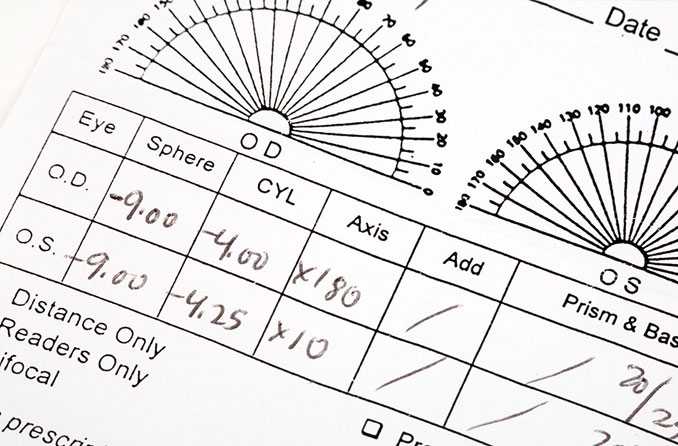
Eyeglass Prescription
So, you've just had an eye exam and your optometrist or optician has given you an eyeglass prescription. He or she probably mentioned that you are nearsighted or farsighted, or perhaps you have astigmatism.
The first step to understanding your eyeglass prescription is knowing what "OD" and OS" mean. some doctors and clinics have opted to modernize their eyeglass prescriptions and use RE (right eye) and LE (left eye) instead of OD and OS.
OD or RE = Right Eye,
OS or LE = Left Eye
Your eyeglass prescription also may have a column labeled "OU."
OU = Both Eyes
Sphere (SPH). This indicates the amount of lens power, measured in dioptres(D), prescribed to correct nearsightedness or farsightedness. If the number appearing under this heading has a minus sign (–), you are nearsighted; if it has a plus sign (+), you are farsighted.
Cylinder (CYL). This indicates the amount of lens power for astigmatism. If nothing appears in this column, you have little or no astigmatism that requires correction.
Axis. This describes the lens meridian that contains no cylinder power to correct astigmatism. The axis is defined with a number from 1 to 180. If an eyeglass prescription includes cylinder power, it also must include an axis value, which follows the cyl power and is preceded by an "x" when written freehand. The axis is the lens meridian that is 90 degrees away from the meridian that contains the cylinder power for astigmatism correction.
Add. This is the added magnifying power applied to the bottom part of multifocal lenses to correct presbyopia. The number appearing in this section of the prescription is always a "plus" power, even if it is not preceded by a plus sign. Generally, it will range from +0.75 to +3.00 D and will be the same power for both eyes.
Prism. This is the amount of prismatic power, measured in prism diopters ("p.d." or a superscript triangle when written freehand), prescribed to compensate for eye alignment problems. Only a small percentage of eyeglass prescriptions include prism. When present, the amount of prism is indicated in either metric or fractional English units (0.5 or ½, for example), and the direction of the prism is indicated by noting the relative position of its "base" (thickest edge). Four abbreviations are used for prism direction: BU = base up; BD = base down; BI = base in (toward the wearer's nose); BO = base out (toward the wearer's ear).
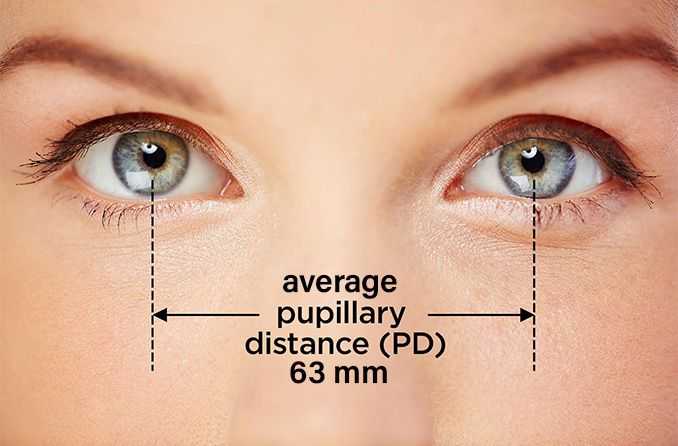
Pupillary Distance Measurement
The average pupillary distance for an adult is about 63 mm, but this is not a number you’ll want to guesstimate.
Your pupillary distance (PD) — the distance between your pupils — determines comfort and how well your glasses fit. Your Optometrist or Optician typically measures PD as part of your eye exam using a pupillary distance ruler or a corneal reflex pupillometer, calibrated specifically to each eye.
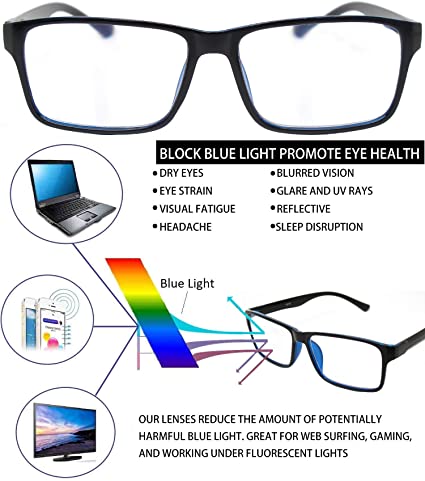
Computer lens
Computer lens able to reflect away the harmful blue light from digital devices such as computer, laptop and smartphone.
Computer Lens are gaining popularity in Malaysia. 3 out of 5 glasses wearers wears this type of glasses. The reason why Computer Lens is so popular nowadays is due to it’s ability to reflect away the harmful blue light from digital devices such as computer, laptop and smartphone. Computer Lens also comes with slight yellowish tint which help to reduce the glare and improve contrast. Glaring screen can cause eye to get tired easily, so Computer Lens will come in handy to reduce tiring eyes.
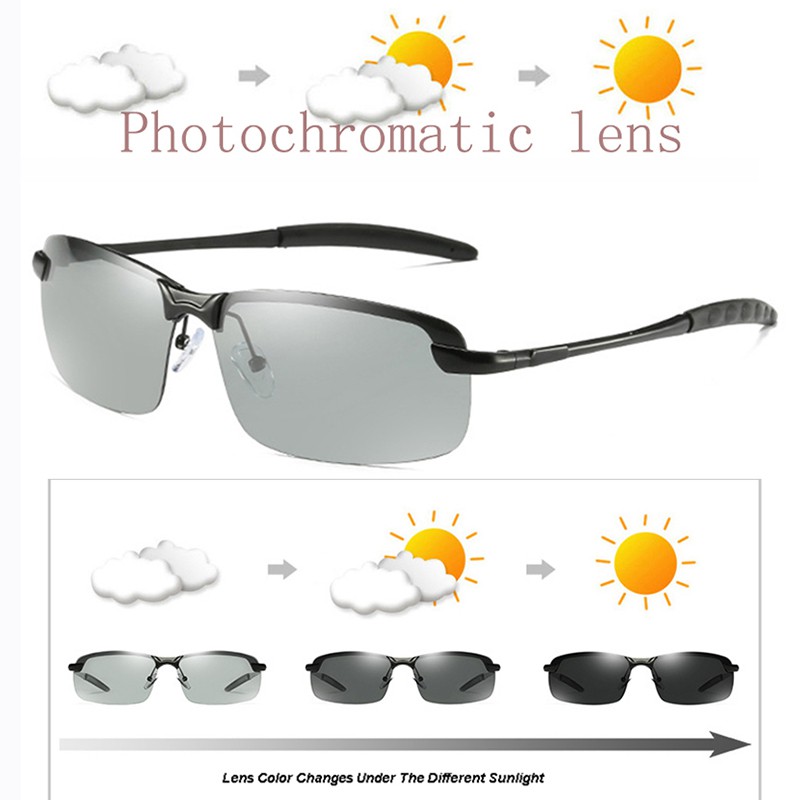
Photochromic lens
Eyeglass lenses that are clear (or nearly clear) indoors and darken automatically when exposed to sunlight.
Photochromic lenses are eyeglass lenses that are clear (or nearly clear) indoors and darken automatically when exposed to sunlight. Other terms sometimes used for photochromic lenses include "light-adaptive lenses," "light intelligent" and "variable tint lenses."
Lens Coatings
Lens coatings can enhance the durability, performance and appearance of your eyeglass lenses.
Anti-reflective coating (also called AR coating or anti-glare coating) is a microscopically thin multilayer coating that eliminates reflections from the front and back surface of eyeglass lenses.
By doing so, AR coating makes your lenses nearly invisible so people can focus on your eyes, not distracting reflections from your eyeglasses.
Anti-reflective coating also eliminates glare caused by light reflecting from your lenses. With reflections eliminated, lenses with AR coating provide better vision for night driving and more comfortable vision for reading and computer use.
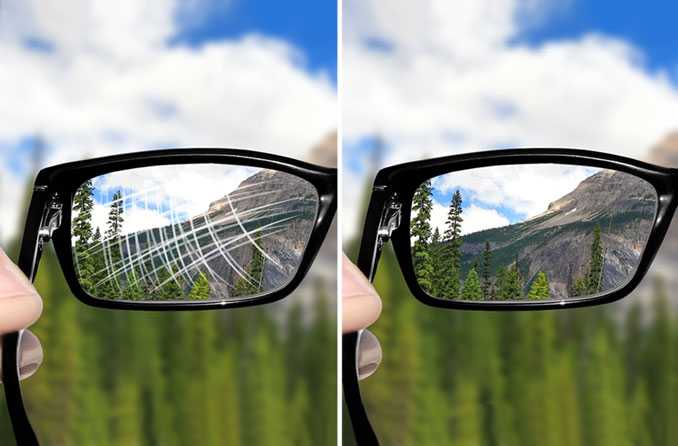
Scratch-resistant coating. No eyeglass lenses — not even glass lenses — are scratch-proof.
However, lenses that are treated front and back with a clear, scratch-resistant coating have a much harder surface that is more resistant to scratching, whether from dropping your glasses on the floor or occasionally cleaning them with a paper towel.
Kids' lenses, especially, benefit from a scratch-resistant hard coat for greater durability.
Ultraviolet(UV protection) treatment. Another beneficial lens treatment is an invisible dye that blocks ultraviolet(UV) light. Just as sunscreen keeps the sun's UV rays from harming your skin, UV-protective treatments for eyeglass lenses block those same rays from damaging your eyes.
Overexposure to ultraviolet light is thought to be a cause of cataract, retinal damage and other eye problems.
-
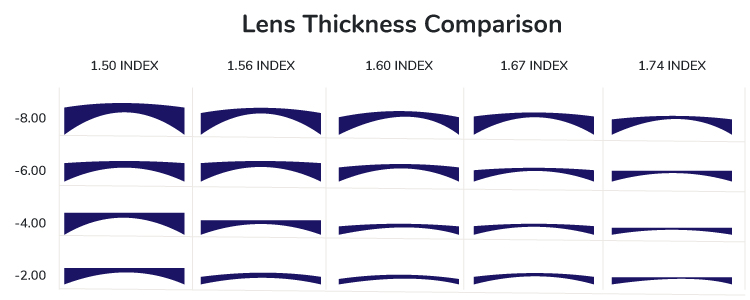
Lens thickness recommendation
- If your power is around -2.00, choose 1.56 index.
- If your power is around -4.00, choose 1.61 index.
- If your power is around -6.00, choose 1.67 index.
- If your power is more than that, choose thinnest lens, 1.74 index.
Glass lenses. In the early days of vision correction, all eyeglass lenses were made of glass.
Although glass lenses offer exceptional optics, they are heavy and can break easily, potentially causing serious harm to the eye or even loss of an eye. For these reasons, glass lenses are no longer widely used for eyeglasses.
Plastic lenses. In 1947, the Armorlite Lens Company in California introduced the first lightweight plastic eyeglass lenses. The lenses were made of a plastic polymer called CR-39, an abbreviation for "Columbia Resin 39," because it was the 39th formulation of a thermal-cured plastic developed by PPG Industries in the early 1940s.
Because of its light weight (about half the weight of glass), low cost and excellent optical qualities, CR-39 plastic remains a popular material for eyeglass lenses even today.
Polycarbonate lenses. In the early 1970s, Gentex Corporation introduced the first polycarbonate lens for safety glasses. Later that decade and in the 1980s, polycarbonate lenses became increasing popular and remain so today.
Originally developed for helmet visors for the Air Force, for "bulletproof glass" for banks and other safety applications, polycarbonate is lighter and significantly more impact-resistant than CR-39 plastic, making it a preferred material for children's eyewear, safety glasses and sport eyewear.
A newer lightweight eyeglass lens material with similar impact-resistant properties as polycarbonate is called Trivex(PPG Industries), which was introduced for eyewear in 2001. A potential visual advantage of Trivex is its higher Abbe value (see below).
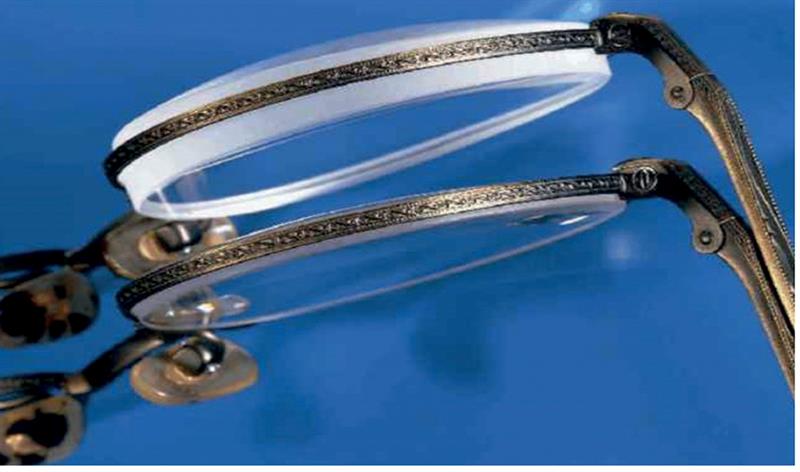
High-index plastic lenses. In the past 20 years, in response to the demand for thinner, lighter eyeglasses, a number of lens manufacturers have introduced high-index plastic lenses. These lenses are thinner and lighter than CR-39 plastic lenses because they have a higher index of refraction (see below) and may also have a lower specific gravity.
Here are popular eyeglass lens materials, arranged in order of refractive index and lens thickness (pretty good indicators of cost). Except for the crown glass, these are all plastic materials.
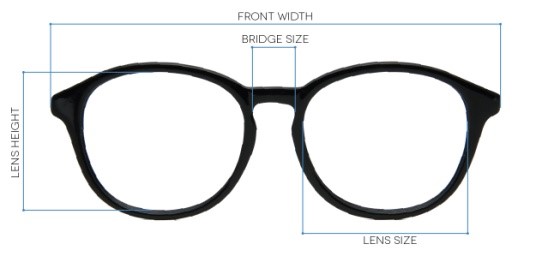
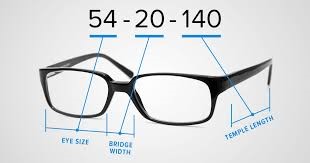
- Lens width: horizontal width of a lens
- Bridge: distance between the lenses
- Lens height: vertical height of a lens
- Temple Length: side temple length
Yes, glasses without prescription is available, simply type “0” into all values of the prescription which includes sphere, cylinder and axis. To avoid any misunderstandings, you can also send us an additional note along with your order.
All the glasses are adjusted before they are delivered to ensure a proper fit. If your glasses still do not fit properly, an optician/ optometrist can adjust the frame for you. Please do not adjust the frame yourself as it could cause damage to the frame.
If you are not satisfied with your glasses, you can also notify us at
Email : [email protected] or
and provide us photo and order ID. We will get back to you with our management decision and solution within 48 hours.
Strict No Refund Policy
Please note that all orders are strictly non-refundable once they have been shipped out. No cash refunds will be provided under any circumstances.
Returns & Exchange Policy
At shopmrlens.com, customer satisfaction is our priority. All products are carefully inspected and verified for quality assurance before being shipped from our warehouse.
Strict No Refund Policy
Please note that all orders are strictly non-refundable once they have been shipped out. No cash refunds will be provided under any circumstances.
Upon Receiving Contact Lenses
Customers are required to inspect their items immediately upon receipt. Please check for:
- Opened or tampered seals
- Packaging defects
- Prescription errors (Power, CYL, Axis, BC, Dia, Color)
Any issues must be reported within 48 hours of receiving the goods. Items reported after this period will be deemed accepted in perfect condition.
Return Requirements
- All items must be unused, unopened, and in original condition
- All original packaging must be retained for return
Claim Process
Step 1: Provide clear photos showing the defect
Step 2: Email us at [email protected] with:
- Order ID
- Reason for claim
Our team will review and respond within 48 hours with a decision.
Resolution Policy
If the issue is verified to be due to our error:
- Compensation will be provided in the form of a voucher only
- Voucher validity: 1 year from the original purchase date
- No monetary refund will be issued
Mr Lens reserves full discretion in all cases to approve, replace, or reject any claims.
Additional Terms
- We are not liable for any lost shipments during return transit
- Replacement processing will only begin after the returned goods are received and verified